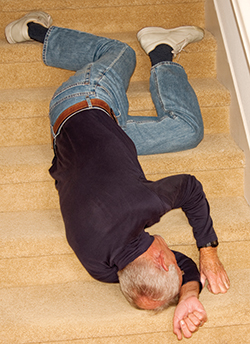
Falls – Steps you can take now to prevent them

fallenman
Be proactive to prevent falls that could change your future.

I have been talking with a lot of groups and individuals about ways to prevent falls. Falls come out of nowhere most of the time. You don’t even think about them until they happen.

According to data from the Centers for Disease Control, there are over 2.8 million older adults seen in the emergency department for falls every year! Yes, 2.8 million!!!   And these are not always the obvious people who can just look at and tell they could easily fall. Many would consider themselves health, active, and not at risk.

You CAN determine your risks and take action now to lower them.

So, how do you determine if you have this falls risk?

The Center for Disease Control tackled that question and developed the Stopping Elderly Accidents, Deaths, and Injuries. They created a toolkit with several resources. Some of the resources are for your doctor or other healthcare provider. Others are for YOU to help find and minimize your personal risks.

You can find access to these tools on our Meds MASH website. Or you can follow this link: https://www.cdc.gov/steadi/patient.html. You will find information about falls, how often they happen, and many of the risk factors. You will also find tools to help you assess yourself and your home.

I especially encourage you to complete the Check for Safety checklist. It has you walk room to room through your house looking for specific risk factors. It also has several tips to help you avoid falls.

Next, I encourage you to complete the Stay Independent checklist. This will ask you a series of 12 questions. You will answer each with a ‘Yes’ or a ‘No’. Then, take this list with you to your next doctor’s appointment. This will help you to have a very focused talk with your doctor about ways to minimize your falls risk.

Finally, read the What You Can Do to Prevent Falls brochure. This will give you even more tips to help you avoid a fall.

What can you do to lower your falls risk?

There are four different assessments in the toolkit that your doctor can use to better understand how to help you decrease your risks. One of these you can do yourself.

It is called a Chair Rise Exercise. It can help you gain strength in your thighs and buttocks. This will help you be more stable when you walk. Here are the instructions from the CDC STEADI guide:

How to do it: 

  1. Sit toward the front of a sturdy chair with your knees bent & feet flat on the floor, shoulder-width apart.
  2. Rest your hands lightly on the seat on either side of you, keeping your back & neck straight & chest slightly forward.
  3. Breathe in slowly. Lean forward & feel your weight on the front of your feet.
  4. Breathe out & slowly stand up, using your hands as little as possible.
  5. Pause for a full breath in & out.
  6. Breathe in as you slowly sit down. Do not let yourself collapse back down into the chair. Rather, control your lowering as much as possible.
  7. Breathe out.

What about medications?

There are so many medications that can increase your risk for falls. That’s one of our specialties at Meds MASH. We can take a thorough look at all of your prescribed medicines, your over-the-counter medicines, your vitamins, your herbal medicines, and any other substances. Even the doses you take, your kidney function, and your liver function will be assessed. We will also look at the timing of your medicines and your diet. All of these things work together to impact your falls risk.

For more information contact us at www.medsmash.com and 410-472-5078.

BIBLICAL APPLICATION

One of the best ways to avoid falls is to know your risks and take steps to minimize them. You need to do some work, and usually get some professional input, to fully analyze those risks. Then, it takes personal motivation to do the exercises, change the shoes, use the assistive device, or work with your healthcare team to make the medication changes to lower your risks.

What are your risks to fall off the path of Christ? I’m thinking of the parable of the seeds found in Matthew 13.

Matthew 13:8 NLT

Still other seeds fell on fertile soil, and they produced a crop that was thirty, sixty, and even a hundred times as much as had been planted!

How do we avoid the thorns, the rocks, the birds, the hot sun, and the shallow soil that kept the other seeds from growing?

Jesus explains the parable later in the chapter.

Matthew 13:23 NLT

The seed that fell on good soil represents those who truly hear and understand God’s word and produce a harvest of thirty, sixty, or even a hundred times as much as had been planted!

God’s Word and the value of our studying, understanding, and applying it are found throughout the Bible. It is throughout the Hebrew Bible, Proverbs, Psalms, and throughout the New Testament.

2 Timothy 3:16 ESV

All Scripture is breathed out by God and profitable for teaching, for reproof, for correction, and for training in righteousness,

Proverbs 4:20-22 ESV

My son, be attentive to my words; incline your ear to my sayings. Let them not escape from your sight; keep them within your heart. For they are life to those who find them, and healing to all their flesh.

Isaiah 40:8 ESV

The grass withers, the flower fades, but the word of our God will stand forever.

Psalm 119:105 ESV

Your word is a lamp to my feet and a light to my path.

John 14:21 MSG

“The person who knows my commandments and keeps them, that’s who loves me. And the person who loves me will be loved by my Father, and I will love him and make myself plain to him.”

What is your grasp of the Word of God? If that is the key to ‘letting our seed grow’, what is your growing potential? I know I have rocks and thorns and birds that try to snatch my seeds away in my life.

It takes motivation and discipline to stay in God’s Word on a regular basis. It takes discussion and study with others to really understand it from varying perspectives. And, it takes talking about it with other people to apply it.

People, instructors, pastors, mature Christians can help you gain the self-insight needed to really determine where your stumbling blocks are. Sharing and accountability help us stay focused and commit to the spiritual exercise, assistive devices, and work required to maintain ‘fertile soil.’

Psalm 1:1-3 ESV

Blessed is the man

    who walks not in the counsel of the wicked,

nor stands in the way of sinners,

    nor sits in the seat of scoffers; 

but his delight is in the law of the Lord,

    and on his law he meditates day and night.

He is like a tree

    planted by streams of water

that yields its fruit in its season,

    and its leaf does not wither.

In all that he does, he prospers.

Blessings,

Michelle

Image source: National Library of Medicine, National Institutes of Health, United States Department of Health and Human Services

Lonely path of chronic illness

The Road of Chronic Illness is (Sometimes) Lonely

Lonely path of chronic illness
Take these steps to stay motivated in the care of a chronic illness.

Have you experienced this? You have new symptoms, so friends and family are concerned and checking on you. You get a new chronic diagnosis, and friends and family are concerned and supportive.

Then, the ‘new’ wears off. The condition continues. The treatment continues. But, the concerned and supportive people have moved on to other issues.

How do you stay motivated to stay on your therapy? How do you stay focused on the necessary steps to control your medical condition? How do you maintain your resolve to stay healthy?

Chronic Illness can be Silent

Have you been diagnosed with high blood pressure, high cholesterol, diabetes, asthma, or arthritis? Have you had a stroke or a heart attack? There are so many types of chronic medical conditions.

Some of these conditions you don’t feel. Your blood pressure can be high, and you feel completely fine.   The same is true with your cholesterol. Even with diabetes, it can get pretty far from normal with no symptoms for many people.

Then, there is the fact that all medications can cause side effects. So, sometimes people feel worse on their medicine than they do when they don’t take it. Talk about hard to stay motivated!

Chronic Illness requires Understanding

One of the key factors in taking care of yourself is really understanding your condition and the treatment. If you have a chronic illness and you don’t fully understand it, please talk with your doctor, your pharmacist, or call us at Meds MASH. It is very hard to know how to take care of yourself if you don’t understand the what, why, how, when aspects of your condition. And it is VERY hard to stay motivated without this understanding.

In addition to the condition itself, you need to really understand the therapy that is prescribed. This can be medication, exercise, diet changes, physical therapy, counseling, or many other kinds of therapy. You need to know why, how this therapy can help, and what you can expect. If there are common side effects, you should know that. If it will take a month to work, you need to know that.

Chronic Illness is Easier to Manage with Support

I was talking about this with some friends who are in recovery from substance abuse. Addiction is one of many types of chronic illnesses. It is also an area that has repeatedly proven the value of support when conquering chronic illness. The 12-step program of recovery is built around the need for community, accountability, and belief in a higher power.

There are support groups available for most medical conditions. Some are groups that meet in person. Some are led by a health professional, others are peer led. Some are groups that meet and interact online.

It can be helpful to know that you are not alone. Most people benefit from sharing their experience, exchanging tips of what works and what doesn’t for them, and just supporting each other. We all have our good days and bad. In a group, someone will be having a good day and be able to help you through your bad day. Next time, you can be the helper and supporter.

If we can help you find a support group or help you to REALLY understand your condition and treatments, please contact us at www.medsmash.com or 410-472-5078.

BIBLICAL APPLICATION

The path of chronic illness is easier to walk with support – family, friends, and a support group of people with the same chronic illness. Likewise, the path of spiritual growth is easiest to walk in community with other believers.

Having other believers around you helps in many ways:

  • Work through questions
  • Share ideas and insights
  • Hold each other accountable
  • Comfort each other
  • Celebrate with each other
  • Pray together
  • Live life together

1 Thessalonians 5:11 ESV

Therefore encourage one another and build one another up, just as you are doing.

Hebrews 10:25 ESV

Not neglecting to meet together, as is the habit of some, but encouraging one another, and all the more as you see the Day drawing near.

I like the way God created us to work together through life and support each other.

Jesus promises he is with us always. So, no one is ever alone. Having friends, small groups, teachers to remind us of that and share their never alone stories can be very helpful.

1 Peter 5:7 ESV

Casting all your anxieties on him, because he cares for you.

Hebrews 13:5 ESV

Keep your life free from love of money, and be content with what you have, for he has said, “I will never leave you nor forsake you.”

One of the verses that I always find most comforting, especially when I’m feeling lonely, self-conscious, or insecure is this next one.

Romans 8:35-39 ESV

Who shall separate us from the love of Christ? Shall tribulation, or distress, or persecution, or famine, or nakedness, or danger, or sword? As it is written, “For your sake we are being killed all the day long; we are regarded as sheep to be slaughtered.” No, in all these things we are more than conquerors through him who loved us. For I am sure that neither death nor life, nor angels nor rulers, nor things present nor things to come, nor powers, nor height nor depth, nor anything else in all creation, will be able to separate us from the love of God in Christ Jesus our Lord.

You and I are never alone. We are unconditionally loved!

Blessings,

Michelle


serotonin syndrome - know and avoid

Depression Treatment & Serotonin Syndrome – Avoid

serotonin syndrome - know and avoid
Avoid serotonin syndrome with careful medication review by doctors and pharmacist.

Last week we reviewed medication treatment of depression and anxiety. Medications impacting serotonin to help regulate mood were a focus. Did you know you could get too much serotonin? When we overdo it, there is a condition called serotonin syndrome that can occur.

I saw a patient that really made me think about this. He is on three antidepressant medications and a couple of other medications that can interact with those. All of them will increase his serotonin levels. I immediately alerted his primary care provider.

Three main scenarios

There are three key ways serotonin syndrome typically occurs:
1. Too many antidepressants, often from more than one doctor. If those doctors don’t know what the others are doing, more than one can start treating the same condition.
2. Self-treatment in addition to prescribed treatment. In particular, St John’s wort increases serotonin. Because there is no regulation for products such as St John’s wort, one bottle can have a different amount than another, so one bottle might lead to too much serotonin while another does not. Several over-the-counter medications can also increase serotonin to dangerously high levels when used with antidepressant medication.
3. Interactions with other medications. There are several other medications for completely different medical conditions that can increase the serotonin effects of antidepressant medications.

Symptoms

When someone has too much serotonin then a condition called serotonin syndrome can occur. The symptoms, especially early on and with a mild version, can be mistaken for a viral illness. These milder symptoms are fever, chills, diarrhea, muscle aches or spasm or rigidity. Other symptoms can be confusion, feeling irritable, or feeling disoriented. Your heart might beat faster and blood pressure could go up.

With more severe serotonin syndrome, seizures, coma, changes in heartbeat, and even unresponsiveness are possible. The most severe cases can lead to death.

Prevent Serotonin Syndrome

Your best defense against serotonin syndrome is to be very open with all of your doctors and your pharmacist about each medication you take. Ask each of them to carefully evaluate your entire regimen.

Do not change your dose on your own. Increasing your dose without guidance increases your risk of serotonin syndrome.

Adding medications you choose to take on your own can increase risk. Medications that can increase serotonin include those you take for cough, for other mood disorders, for pain, for migraine, for nausea, and for some infections. The list is so long, I encourage you to make sure you always share all of your medicines with all of your healthcare providers.

Note, even herbal medications and illicit medications can increase serotonin.

Please don’t be afraid or stop your antidepressant

The purpose of this blog is to make you aware, not to make you afraid. When taken at appropriate doses, antidepressants have aided in the resolution of depression for many people. Keep in mind; counseling is a key part of depression therapy versus medication alone. Keeping your entire medical team involved in each aspect of your care and how you feel during therapy will help avoid issues such as serotonin syndrome.

I want to remind you to never stop your antidepressant/antianxiety medication all of a sudden. Your healthcare team will guide you through a gradual tapered withdrawal when that is warranted.

For information about depression and anxiety treatment, serotonin syndrome, and drug interactions, please contact us at Meds MASH at 410-472-5078 or www.medsmash.com/contact.

BIBLICAL APPLICATION

This might be a loose association, so please stay with me here. I found that people with lingering depression and/or their loved ones seek relief from multiple sources. They sometimes combine prescription medications with herbal therapies with cognitive behavior therapies with religion with any other options for which they find anecdotal evidence. I typically do not hear the full picture at my first visit. It is with time and the building of trust that I get the full story. Sometimes those mixtures of therapies work, and other times they lead to more problems.

I think the same can be true with spiritual growth options. There is a lot of information ‘out there’. You can find speakers, books, videos, churches, ministries, and blogs that will tell you just about anything.

I have mentioned before the rapid growth of para-spiritual businesses that exist to help people feel better. Many of them are quite centered on the person rather than on the One True God.

Discernment is key with so many voices and messages to select. And, wow, this is so much easier to type than to do.

Jesus, Paul, John, Solomon, James, and others throughout the Bible encourage us to be careful. Follow God’s word, follow the leading of the Holy Spirit, and don’t fall for just anything that you hear.

1 John 4:1 ESV

Beloved, do not believe every spirit, but test the spirits to see whether they are from God, for many false prophets have gone out into the world.

I like this passage even better in The Message:

My dear friends, don’t believe everything you hear. Carefully weigh and examine what people tell you. Not everyone who talks about God comes from God. There are a lot of lying preachers loose in the world.

When you’re not sure what you’re hearing is right, take a time out. Go to the Bible. Talk with spiritually mature Christians. Pray for guidance. Hasty decisions can quickly get you into trouble.

James 1:5 ESV

If any of you lacks wisdom, let him ask God, who gives generously to all without reproach, and it will be given him.

You’re smart, but that doesn’t mean you can’t get caught up in false information.

Matthew 24:24 ESV

For false christs and false prophets will arise and perform great signs and wonders, so as to lead astray, if possible, even the elect.

There are so many confusing messages in our World.   Just this past week alone has bombarded you with message of right and wrong and what you should believe.

Romans 12:2 ESV

Do not be conformed to this world, but be transformed by the renewal of your mind, that by testing you may discern what is the will of God, what is good and acceptable and perfect.

Don’t beat yourself up if you’re confused. It is a smart thing to question all you hear, read, see, and experience.

1 Timothy 6:3-5 ESV

If anyone teaches a different doctrine and does not agree with the sound words of our Lord Jesus Christ and the teaching that accords with godliness, he is puffed up with conceit and understands nothing. He has an unhealthy craving for controversy and for quarrels about words, which produce envy, dissension, slander, evil suspicions, and constant friction among people who are depraved in mind and deprived of the truth, imagining that godliness is a means of gain.

Jesus tells us to expect this confusion. He also tells us to be wise, discerning, smart, and loving all at the same time. And HE is the one who can help us do that. You can’t do it alone.

Matthew 10:16 ESV

“Behold, I am sending you out as sheep in the midst of wolves, so be wise as serpents and innocent as doves.

I’m praying we each seek the truth through the One who is and was and is to come.

Blessings,

Michelle

SSRI dosing

Anxiety and Depression Medications – Step Up, Step Down

SSRI dosing
Depression and anxiety medications should be started and later stopped in gradual steps.

Sometimes you can start a medicine and it starts working right away. Sometimes it takes a while to work. Sometimes you can stop a medicine ‘cold turkey.’ Sometimes you can’t without risky side effects. Some require step up and step down dosing.

I believe it is very important to understand a medication, how it works, how to best use it, and how to avoid problems. There are a lot of these tidbits that are important in the use of anxiety/depression medications. The most commonly used anxiety/depression medications right now are in a class called ‘selective serotonin reuptake inhibitors’ (SSRIs).

The class name describes how they work. I’m going to try to break it down into steps that make sense.

Neurotransmitters

The first step is to have some understanding of neurotransmitters. They are the brain’s messengers. They carry messages from one nerve to another.

Some of the main neurotransmitters are:

  • Epinephrine – adrenalin, drives the sympathetic system and your ‘fight or flight’ response when you are scared, in stress, or in danger
  • Norepinephrine – also drives the sympathetic system causing you to feel awake, ready for the day, able to manage stress
  • Dopamine – mainly related to movement; increasing this is key in the treatment of Parkinson’s Disease
  • Serotonin – manages your mood, appetite, sleep, and movement of your gastrointestinal tract

Neurotransmitters are passed from nerve cell to nerve cell. As a neurotransmitter leaves one nerve cell, it goes into a space between the end of that nerve cell and the beginning of the next nerve cell. This space is called the synapse.

The beginning of the next nerve cell has receptors.   Neurotransmitter in the synapse (the space) will bind to a receptor. That will allow it to get into the nerve cell and create an electrical signal that will travel through it to the end and continue the message to the next neuron in the same manner. At the end, it will be released into the synapse where it can be picked up by the receptors of the next nerve cell. In this way, the message travels through the whole nerve system.

When there is too much neurotransmitter in the synapse, the nerve cell that released it can take it back. This is called reuptake.

The body has amazing processes to regulate itself. In this case, release from a nerve cell, time in the synapse, and binding to a receptor in the next nerve cell are all carefully synchronized.

Serotonin, depression, and anxiety

Serotonin is one of the primary neurotransmitters for the regulation of mood and sleep. When someone is depressed, it might be because serotonin transmissions are too slow.

When someone is experiencing anxiety, serotonin levels might be out of balance.

The role of selective serotonin reuptake inhibitors is to prevent the first nerve cell from taking back the extra serotonin it has released. This will make more serotonin available for the receptor of the next nerve cell. This will allow more serotonin to be passed from nerve cell to nerve cell.

Product delivery analogy

Imagine you have created a product that is a popular gift for special occasions. During most months the demand for your product stays steady for events such as birthdays.

On these months, you keep a regular supply of product in your warehouse. Ten distribution trucks can get the products to the stores that sell your product. This keeps the stores supplied with enough product for customers each month. If a store has several products that have not sold, they will send them back to the warehouse in the delivery truck.

Then, there are two months when the demand goes way up. During these two months, you stock your warehouse with much more product. You hire 10 more distribution trucks. You stop taking any product back to the warehouse from the stores. All product is moved from the warehouse to the stores.

Then, in the month after the rush, demand gradually decreases. It does not immediately go back to normal. People exchanging gifts often exchange their original gift for your product. Others see their friends with your product and want one for themselves. Then eventually, the demand is back to normal.

In this analogy, your product is the serotonin. The warehouse is the nerve cell that stores the serotonin. The delivery truck is the receptor that will transport the serotonin into the next nerve cell to continue the message.

Why Step Up and Step Down?

Increasing the availability of serotonin takes time. The nerve cells can’t immediately stop the reuptake process. The receptors don’t immediately increase in number to use more of the available serotonin. The entire central nervous system doesn’t immediately respond to the extra serotonin. That whole process takes about 8 weeks. At around 4 weeks the doctor prescribing the SSRI might increase the dose if your energy is not starting to pick up.

Similarly, it takes time for the body to adapt when the medication is stopped. Usually, if someone with a first episode of depression has been treated for six months and is feeling good, then the SSRI can be stopped. However, it shouldn’t be stopped all at once. It will again take the nervous system time to adapt to a change in the medication. So, the dose needs to be very gradually decreased over a few weeks. If it is stopped all at once you could feel dizzy, tired, anxious, achy, irritable, nauseous, like your skin is prickly, or other symptoms. The receptors and nerve cells need time to take back over the serotonin transmission without assistance.

NOTE, this does not mean you are addicted. It means your body has adapted to the medication and needs time to adapt back to being without the medicine.

Disclaimers – Everyone will have times in life with highs and lows. Each low is not a type of depression that requires treatment. A professional makes the diagnosis of depression or anxiety requiring treatment. The treated depression or anxiety has usually lasted several weeks to months and is impacting daily life activities.

If this leaves you with questions, please contact us at Meds MASH at 410-472-5078 or www.medsmash.com/contact.

BIBLICAL APPLICATION

The step therapy of SSRI’s reminds me a common path of helping other people find Christ.

Often someone who doesn’t know Christ will hesitate to find an accept Him all at once. Sometimes it is years of small events, people, exposures, or discussion that gradually lead to real interest. Even from there, developing understanding and real seeking can take more time. At some point after all of this exposure and searching, the person reaches the point of accepting Christ and moves to leading a life of following Christ. As a believer in that person’s life, you can’t just wash your hands and walk away. This new believer is in a fragile state. The excitement, joy, and intentions are very real. Do you remember how awesome that time period was, if you are a believer who came to Christ over a period of time of searching? If you walk away now, that new believer could be like the seed that falls on rocky ground from the Parable of the Sower.

Matthew 13:5-6 ESV

Other seeds fell on rocky ground, where they did not have much soil, and immediately they sprang up, since they had no depth of soil, but when the sun rose they were scorched. And since they had no root, they withered away.

Jesus goes on to explain this parable (found Matthew 13:1-23), and the explanation of this part is:

Matthew 13:20-21 ESV

As for what was sown on rocky ground, this is the one who hears the word and immediately receives it with joy, yet he has no root in himself, but endures for a while, and when tribulation or persecution arises on account of the word, immediately he falls away.

Following Christ can seem so obvious, so right, so easy at first.   But, life is full of road bumps, dead ends, and hardship. A brand new believer can quickly and easily become disillusioned. You know Satan will be lining up these difficulties to create just this situation. So, you can’t just walk away and feel that your work is done.

Support for a new believer is at least as important as helping others find Christ.

As the new believer learns to communicate, read God’s word and listen for His voice, and find friendships with other believers, then your role will gradually be less critical. It doesn’t go away, but the frequency of your interactions might decrease.

The role of continued fellowship and connection with other believers is found throughout the Bible.

Romans 1:12 ESV

That is, that we may be mutually encouraged by each other’s faith, both yours and mine.

1 Thessalonians 5:11 ESV

Therefore encourage one another and build one another up, just as you are doing.

Hebrews 10:25 ESV

Not neglecting to meet together, as is the habit of some, but encouraging one another, and all the more as you see the Day drawing near.

So, I found it interesting to consider how we step up when introducing someone to Christ and step down as they grow and mature in their faith.

Blessings,

Michelle

Break the Circle of Self

Depression, Pain, Anxiety – the Circle of Self

Break the Circle of Self
The Circle of Self can lead you into a dark self-absorbed place with pain, depression, and anxiety.

I was teaching health profession students this week about mental health and pain. The Circle of Self was a good visual way to capture a current phenomenon. One of the very important things we talked about was the LIMITS of MEDICATION! The students were very insightful about the reasons so many people are struggling with depression, anxiety, and pain. And, the more we talked, the more it made sense that this is a common pattern.

STRESS

We made a list of reasons why the incidence of depression, pain, and anxiety are so common. I would love to hear what you would add to this list. Current themes in our society that contribute are:

  • Stress
  • Anxiety
  • Decreased coping skills
  • Social media – most posts are either deceptively positive to look good or very negative
  • News, especially so much bad news
  • Poor sleep hygiene
  • Expectation of instant gratification
  • Reliance of medications or techniques to ‘just fix it’

THE CIRCLE OF SELF

When someone experiences depression, anxiety, and/or pain, several things tend to happen:

  • Less movement – more sitting or lying around
  • Decreased social activities – stay home more, reject offers to get out
  • Nod off or purposefully take a nap during the day
  • Have interrupted sleep at night
  • Experience pain – either pain when there was none or worsening pain

These changes lead to more and more focus on self. How do I feel? What is happening to me? Why me? Why do I feel this way? Why can’t I sleep? Why can’t I get motivated? Woe is me…

This common pattern of self can also impact heart disease, diabetes, obesity, and more.

The role of SLEEP

Most adults need 7-9 hours of sleep per night. As we age, more and more things seem to interrupt this sleep. You might need to go to the bathroom more often during the night.   Pain can wake you up or keep you awake. Napping during the day can mess with your nighttime sleep.

Too little sleep can increase your risk of depression. It can also make your recovery from depression most difficulty.

Too little sleep can limit your ability to manage with pain. Pain can feel worse, be more frustrating, and limit your activities more when you’re extra tired. Also, the more you hurt, the hard it is to sleep, and a vicious cycle is started.

The role of MEDICATION

Low amounts of key neurotransmitters in the brain can lead to depression and/or anxiety. There are medications that can help increase the amounts of those neurotransmitters. Note, this process takes about 8 weeks, so starting medicine doesn’t make you feel better right away. Usually your energy gets better before your depressed or anxious thoughts.

In the studies that showed that these medications can help, counseling was also a key part of therapy. The medications by themselves don’t help as much as they do when you also have counseling. It is the counseling that can help you find some different ways to think, stop the negative thoughts, and help you focus on more positive aspects of your life.

For pain, some medications block some of the pain signals going between the site of the pain and your brain. Others decrease the intensity of those signals. The pain medication should match the type and intensity of the pain. This means the same pain medication is not the best option for all types of pain. There have been huge issues in our society of overuse of pain medicine, especially opiate medications. These have a role in some types of pain. Once the pain starts to decline, the medication should be decreased and stopped. In another blog, I’ll review all of the many types of pain medications and when/how to use each.

Breaking the Cycle

Breaking the circle of self
Think of others to break the circle of self.

Medications are part of breaking the cycle for many people. Note, medication is often helpful to start the process. It might not be needed long term. Ask you doctor about how long it will be helpful for you.

Counseling is part of breaking the cycle. Learning to change your thinking patterns is key. Having support is also key.

Then, I want to share something that has repeatedly been shown to effectively break this cycle. Do something for someone else! Focus on self leads into the negative circle that gets tighter and tighter, isolating you from others. To purposefully think about others can help you out of this dark place. Call to check on a friend. Help someone with a project. Visit an older relative or friend. Take a meal to a new parent or someone who is sick. Make a donation. Write a letter to a soldier. Plan a special outing with a friend. Join a club that works on a social issue.

There are many options! The point is to find someone else you can think about and help. Distraction is helpful for pain tolerance, anxiety reduction, and depression treatment. Thinking about someone else helps you out of the dark focus on self.

For more information about breaking the circle of self, contact us at www.medsmash.com/contact or 410-472-5078.

BIBLICAL APPLICATION

I believe the circle of self can and does impact all of us. It is one of Satan’s best weapons. How distracted do you get when you are in pain? How about when you are feeling down or anxious? Even a common cold can be very distracting. And, once you are distracted, how hard is it to pull back out of the negative cycle?

Peter encourages us to recognize all of this and to learn to think more like Jesus.

1 Peter 4:1-2 MSG

Since Jesus went through everything you’re going through and more, learn to think like him. Think of your sufferings as a weaning from that old sinful habit of always expecting to get your own way. Then you’ll be able to live out your days free to pursue what God wants instead of being tyrannized by what you want.

In these complex times, we are bombarded with information that can keep us stressed, anxious, and/or depressed. Paul tells us to not focus on these things. He encourages us to focus instead on what comes next. How much time do you spend thinking about your future in Heaven?

2 Corinthians 4:14-18 MSG

 We’re not keeping this quiet, not on your life. Just like the psalmist who wrote, “I believed it, so I said it,” we say what we believe. And what we believe is that the One who raised up the Master Jesus will just as certainly raise us up with you, alive. Every detail works to your advantage and to God’s glory: more and more grace, more and more people, more and more praise!

So we’re not giving up. How could we! Even though on the outside it often looks like things are falling apart on us, on the inside, where God is making new life, not a day goes by without his unfolding grace. These hard times are small potatoes compared to the coming good times, the lavish celebration prepared for us. There’s far more here than meets the eye. The things we see now are here today, gone tomorrow. But the things we can’t see now will last forever.

Thinking about others, loving others as much and in ways we love ourselves, and putting others before ourselves are common themes in the Bible.

Philippians 2:3 ESV

Do nothing from rivalry or conceit, but in humility count others more significant than yourselves.

Romans 12:10 ESV

Love one another with brotherly affection. Outdo one another in showing honor.

1 Peter 3:8 ESV

Finally, all of you, have unity of mind, sympathy, brotherly love, a tender heart, and a humble mind.

I’m praying we can all keep our focus outside of ourselves. Love others and keep your eyes on the future – eternity in Heaven!

Blessings,

Michelle

Serenity

Happy in 2017 – Let Go of Control to Find Health

Serenity
Let go of control and let go of anxiety, depression, and pain

I’ve mentioned before, the three types of medications prescribed most commonly in the United States treat anxietydepression, and pain. I propose CONTROL is in the midst of this frequent prescribing.

What happy, exciting things do you anticipate for 2017?

What fears, concerns, or dread do you have for 2017?

CONTROL

How much control do you have over the good things you anticipate?

How much control do you have over the things that concern you?

How well do you deal with the instances where you have no control?

I have had patients who rarely leave their house for fear of what could happen while out that they wouldn’t be able to control. Some fear injury or accident. Some fear having to interact with other people. Some fear having to make a decision for which they’re not prepared.

Other patients have had bad experiences they were unable to control. Someone they loved died, left, or now rejects them. In other cases, they were in an accident, hurt by someone, or had some other negative event they fear could repeat.

All of this worry directly impacts rates of anxiety, depression, and even pain. When worry doesn’t find an outlet, it can lead to pain, often chronic pain.

Letting go of control

Want to ease into 2017 with less burden and more lighthearted joy? Try letting go!

The Serenity Prayer that is prayed in 12-step programs is:

‘God grant me the serenity to accept the things I cannot change,

Courage to change the things I can,

and the Wisdom to know the difference.’

This is a powerful prayer. It acknowledges that there is so much beyond our control. Try as we might, we just cannot control or change some things.

For instance, I know a lot of people are incredibly tense about the implications of a new president in2017. They stew about the ‘what-ifs’. They worry about all of the things that could go wrong. They read each prediction, especially from the sources that don’t support the newly elected official. It’s all they think about, talk about, read about, watch on TV. They get more and more anxious as they continue on this circular path.

I know people who fear certain diagnoses such as cancer, heart disease, or Alzheimer’s Disease. They jump on any unusual symptom. Their frequent use of the medical system often leads to the prescribing of several medications. All of these medications interact causing problems of their own. As the person feels worse, the more they fall down this negative slippery slope.

Hope for 2017

Consider how the Serenity Prayer could be your mantra for 2017. Spend your energy, thoughts, and time on things that are positive. Do the things you enjoy. Spend time with those who love and support you. Reach out and help others.

For the many, many things in this world that could go wrong – Let It Go! If you can’t control it, admit that and let it go.

This change could actually mean less anxiety, less depression, and less pain.

For more information about the link between control and health, please contact us at 410-472-5078 or www.medsmash.com/contact.

BIBLICAL APPLICATION

Here is the full Serenity Prayer. I had never heard/read it until recently.

God, give me grace to accept with serenity

the things that cannot be changed,

Courage to change the things

which should be changed,

and the Wisdom to distinguish

the one from the other.

Living one day at a time,

Enjoying one moment at a time,

Accepting hardship as a pathway to peace,

Taking, as Jesus did,

This sinful world as it is,

Not as I would have it,

Trusting that You will make all things right,

If I surrender to Your will,

So that I may be reasonably happy in this life,

And supremely happy with You forever in the next.

Amen.

I love this! I plan to print it and keep it where I can read it frequently until I can memorize it. What a beautiful prayer for each and every day.

Let Go and Let God!

This is a prime example. Give up control and give it all to God who actually knows what to do with it all.

Peter and Paul very directly give us guidance on how to handle our anxieties.

Philippians 4:6-7 ESV

Do not be anxious about anything, but in everything by prayer and supplication with thanksgiving let your requests be made known to God. And the peace of God, which surpasses all understanding, will guard your hearts and your minds in Christ Jesus.

1 Peter 5:7 ESV

Casting all your anxieties on him, because he cares for you.

As hard as it is to let go of our very human desire to control, WOW, we will feel so much better when we truly give it all to God! (Please keep reminding me as I’ll keep reminding you. Satan DOES NOT want you to remember and apply this on a daily basis.)

Matthew 11:28-30 ESV

“Come to me, all who labor and are heavy laden, and I will give you rest. Take my yoke upon you, and learn from me, for I am gentle and lowly in heart, and you will find rest for your souls. For my yoke is easy, and my burden is light.”

Blessings as you Let it Go,

Michelle

Image source: Winter Icon by Gwebwt.blogspot.com

Peace

Peace, Joy, and Health – What is the Link?

Peace
Peace and Joy can improve your health this holiday season

Merry Christmas! Happy Hanukkah! Happy Holidays! For many this is a season of wonder, excitement, friends, and family. It is a time of joy and celebration. The comforts of the season, and for many, the reasons for the season, are a source of peace.

Then, for others, this is a difficult season. It can be a reminder of loss, a lonely time, or a negative experience. I am regularly horrified at how people can hurt people. And hurt people tend to hurt people. It is a devastating trend.

Hurt and Health

The obvious connection between peace and health pertains to war. I am happy to see survivors finally being moved to safety away from Aleppo. War is definitely hazardous to health. Aleppo has been an example of how horrible things can get in the midst of war.

Conflict, abuse, hurtful words, neglect, oppression, and bullying are bad for your health, too. Anxiety, depression, and loss of hope are some common themes.

These cycles are hard to break. It can be challenging to find the hope.

I have seen in MANY patients that when this hurt is kept inside, it DOES come out. It can come out as depression, social anxiety, avoidance of people, and very often pain.

Peace and Health

Finding peace in life doesn’t only happen when things are perfect. Name the times in your life that absolutely everything was perfect. I’ll be surprised if you can find any at all. Rarely if ever are you in a place where there is absolutely no hurt, no mess, and all is good. So how do you ever find peace?

I have had the privilege of knowing many people, including many patients, who have found peace in spite of very turbulent events in their life.

Finding faith, meaning, and peace has been shown to improve quality of life in people with cancer. Some people bring these qualities into their cancer experience. Others find it in the midst of their cancer. I believe if this is true in cancer, it will be true with other chronic illnesses as well.

Another link is the association between giving to others and finding joy for yourself. Altruism and giving are linked with improved health. We often associate happiness with getting gifts. Now, it appears you will find even more joy if you focus on the giving of the season. Who could benefit from your giving today?

So, on this holiday weekend, seeking your source of peace and joy can actually improve your health. You physical, mental, emotional, and spiritual health will all benefit.

For more information about the health benefits of finding peace in the midst of life, contact us at 410-472-5078 or www.medsmash.com/contact.

BIBLICAL APPLICATION

I know a lot of Christians who struggle to find the peace and joy of Christmas. The busy-ness, stress, expectations, obligations, traffic, and events can be overwhelming.

None of that sounds like peace.

The birth of Jesus wasn’t surrounded by shopping, parties, pressure, or obligations. There might have been some traffic with the census.   🙂

The songs like ‘O, Holy Night’, ‘Silent Night’, and ‘It Came Upon a Midnight Clear’ paint a peaceful, serene event. The rich and famous were not present. The finest china and silver were not set in a well-decorated setting. No one compared value of gifts given and received.

Peace was mentioned to the very first people told about his birth.

Luke 2:14 ESV

“Glory to God in the highest, and on earth peace among those with whom he is pleased!”

Jesus had several messages about peace during his ministry.

John 16:33 ESV

I have said these things to you, that in me you may have peace. In the world you will have tribulation. But take heart; I have overcome the world.”

John 14:27 ESV

Peace I leave with you; my peace I give to you. Not as the world gives do I give to you. Let not your hearts be troubled, neither let them be afraid.

Jesus’ brother James understood the types of things that lead to our stress and frustration at Christmas.

James 4:2-3 ESV

You desire and do not have, so you murder. You covet and cannot obtain, so you fight and quarrel. You do not have, because you do not ask. You ask and do not receive, because you ask wrongly, to spend it on your passions.

Paul tells us what we should do instead.

Galatians 5:22 ESV

But the fruit of the Spirit is love, joy, peace, patience, kindness, goodness, faithfulness,

Jesus demonstrated this kind of life. Christmas is a time of love, joy, peace, patience, kindness, and goodness. How delightful if we can stay focused on these principles as we celebrate with our loved ones.

I pray Paul’s blessing for you and your family this blessed Christmas.

Romans 15:13 ESV

May the God of hope fill you with all joy and peace in believing, so that by the power of the Holy Spirit you may abound in hope.

Blessings,

Michelle

Perspective

Wrong Assumptions lead to Bad Medicine

Perspective
Avoid wrong assumptions that lead to incorrect actions.

When was the last time you made and acted on wrong assumptions? It is so easy to do. You see something from your perspective and your mind fills in the details of the who, what, when, how, and why. It’s often long after you have acted that you are provided with a different perspective that makes the entire situation look different.

A quick, fun example is in this picture. Another proof that I am a geek. I get such a kick out of these pictures.  If I believed my eyes I might run in to help the poor guy being lifted into the air.

This happens in healthcare, too. Keep in mind, the provider that is making decisions in the emergency department or the hospital usually knows VERY LITTLE about you. Any information you or a loved one or friend can give is all they have at first.

One day, hopefully soon, these providers will be able to access your medical records and make much more informed decisions. Right now, your doctor has to be contacted then the information sent to the hospital. If it is the weekend or an evening, that can take hours to days. The information then needs to get to your hospital provider from the fax machine or the electronic messaging system. Even then, there might be important information about you that is not even in your doctor’s record.

This leaves those of us making decisions about your care to rely heavily on what we see right now.

I have seen SEVERAL examples in the last few weeks of an older adult reaching medical care confused. The quick wrong assumption has been that the person has dementia. When confused, behaviors often change. A confused person can yell, pull at catheters and IV’s, try to get out of bed, and generally not cooperate. Since the assumption has already been made that dementia is the cause, calming medications are given. These then assure further confusion (but calmer) and make it very hard for the person to get to a point of no confusion.

What can you do to prevent wrong assumptions?

  1. Carry in your wallet a list of your:
    1. Allergies
    2. Medications
    3. Diagnoses
    4. Emergency contact information – name, phone number(s)
  2. If you are accompanying someone to the hospital who is newly confused, explain this to the medical team. Help them understand what this person was like before this event. They need to know the ‘baseline’. If this person was living independently, driving, managing their finances the team needs to know that. If this person was unable to do those things and was getting frequently confused at home, the team needs to know that.
  3. Share any known history about the current event. If you have been feeling worse and worse for the past three days, make sure they know that. If you have been having pain, explain that including what it feels like, how often you feel it, what makes it better or worse.
  4. If you have been taking different medications for the past few days, make sure they know that. This often happens when we are in pain or have a cold. We take over-the-counter medications or left-over medications from prior prescriptions. These can cause confusion when mixed with our normal medication regimen.

Speak Up

Again, I have seen several instances in the past few weeks where assumptions are made when someone gets to the emergency department or hospital that make a situation worse.

  • In one instance the person’s confusion started as soon as a particular medicine was given. The family member noted that but didn’t speak up. Then medications were added to treat the confused behaviors. We are still trying to taper off of those medications and get this person independent again.
  • In another instance, the person had a urinary tract infection. These are famous for making older adults confused. But since no one was there to explain how odd this confusion was for this person, the team assumed this was normal and didn’t find the infection for a while.   By then, a couple of medications had been added to treat the confused behaviors. It will take us weeks to taper her back off of these medications.
  • In a third instance, the collection of pain medications given after a surgery left the person sleeping most of the day and unable to think clearly. The spouse was dutifully giving the prescribed medicines around the clock. The wrong assumption made here was that this very healthy person over 60 could handle these medications like someone in their 30’s.
  • One more instance involved using a medication to treat the side effect of another medication. The second medication (the one used to treat the side effect) is on a list of medicines to avoid in people over 60. Rather than treat the side effect, it made the person nearly unresponsive. In this case, as in several of the others, rather than treat the underlying issue, wrong assumptions were made and actions were taken to treat the symptoms without understanding the back story.

Why ‘Bad Medicine’

Just a side disclaimer. When I was contemplating this blog I saw it as a chance to use the terms, ‘Bad Medicine’. I am a big Bon Jovi fan. I am also a pharmacist. So, I have to admit I love the song, ‘Bad Medicine’.

For more information about how to protect yourself from wrong assumptions leading to bad medicine, contact us at Meds MASH at 410-472-5078 or www.medsmash.com/contact.

BIBLICAL APPLICATION

I can think of a lot of bad assumptions leading to bad decisions in the Bible. One of the first is Eve’s decision to eat the apple. The Israelites made bad assumptions continuously. A few that come to mind are thinking slavery would be better than ‘suffering’ in the desert; people in lands they were to conquer were too mighty to overcome; Moses was not going to return so a golden calf was needed. The list goes on.

So, how often do you make bad assumptions? I suggest we all do it every day. We don’t act on all of them. I don’t think we realize most of them.

I am consulting right now in a place that serves a highly diverse and unique population of people. Assumptions about gender, culture, religion, socioeconomic status, or just about anything will quickly lead you down an incorrect path. It has been an adventure of constant striving to avoid any assumptions.

These verses are good ones for me to remember each day:

Proverbs 18:2 ESV

A fool takes no pleasure in understanding, but only in expressing his opinion.

Matthew 7:1 ESV

“Judge not, that you be not judged.

Proverbs 25:8 ESV

Do not hastily bring into court, for what will you do in the end, when your neighbor puts you to shame?

Bad assumptions and temptations to act on them are one more test.

As I understand the Word, truth trumps all of the assumptions. Love trumps all of the wrong actions.

1 Corinthians 13:6 ESV

It (love) does not rejoice at wrongdoing, but rejoices with the truth.

1 Corinthians 13:7 ESV

Love bears all things, believes all things, hopes all things, endures all things.

The laws in Deuteronomy give us good advice even here in 2016.

Deuteronomy 17:13 ESV

And all the people shall hear and fear and not act presumptuously again.

I encourage you (and me) to guard against assumptions and focus on truth and love.

Blessings,

Michelle

Problem Medications sending people to the ER

emergency
Don’t let problem medications send you to the emergency room

Problem medications are leading to an increasing number of emergency department visits. And more and more of those are ending up being admitted to the hospital. A study published in the Journal of the American Medical Association in November 2016 revealed these findings. The study was conducted by the Centers for Disease Control.

For every 1,000 emergency department visits, four are for people over the age of 65 with problem medications. In the last decade the number of people going to the emergency departments with problems with their medicines has gone up at least 10%.

The types of medications most often involved are opioid pain medicines, diabetes medicines that lower the blood sugar, blood thinners (anticoagulants), and antibiotics. There is still a significant use of medicines that have been long-recognized as a poor choice in people over 65. [I am still seeing that in my patients as well. Pain medication, anxiety and mood therapy, and anticholinergic (drying) medication use have been issues in nearly all of my referrals in the past 2 months.]

Why are there more medication-related emergency visits?

Part of the reason for this increase in emergencies could be the growing number of people over 65. But, that can’t be the only explanation.

Speed – Healthcare is moving and being provided at a very fast pace. The time your doctor gets to spend with you is very limited. Often the reason for your visit takes all of the time. This doesn’t allow for a thorough review of all of the rest of your health and your medicines.

Fragmentation – Your doctors, pharmacists, nurses, therapists don’t have enough time to talk to each other. When one doctor doesn’t know what the other one is doing, problem medications can be prescribed.

Incomplete information – Your doctors don’t often know what you REALLY do at home with your medicine. I have identified thousands of instances where medication is taken differently than prescribed. This can be for many reasons. Sometimes medications are stopped without telling the doctor. Sometimes extra doses are taken. Sometimes medications get confused such that each is taken incorrectly. Other times vitamins, herbal supplements, over-the-counter medications, and other substances are taken without the knowledge of the doctor or pharmacist. These are just a few of the examples of how medication can be different than what your doctor thinks it is.

Specialized knowledge – Only a small percentage of people aged 65 plus receives care from a specialist in healthcare for people in this age group. There are not nearly enough geriatricians and board certified geriatric pharmacists to oversee the prescribing for these adults.

Don’t let this statistic apply to you

What can you do to avoid being one of these people in the emergency department because of problem medications?

First, make sure your doctors (all of them) and your pharmacist know absolutely EVERY medication you take AND how you actually take them.

Second, ask your primary care doctor AND your pharmacist to carefully review all of those medications for:

  • Interactions
  • Lowest possible doses
  • Continued need for each medication
  • Safer options available
  • Removal/replacement of any medication known to be problem medications in people over 65
  • Assurance each is working as planned

Third, contact the board certified geriatric pharmacist at Meds MASH for a thorough medication review today. All findings will be shared with your healthcare providers so all can work together to keep your medication regimen safe. You can reach Michelle at www.medsmash.com/contact or by calling 410-472-5078.

Mistakes, oversights, misinformation, incomplete information, misunderstandings occur in all aspects of life. They certainly exist in healthcare. NO healthcare provider wants imperfect care, but it certainly happens. This is why a multi-check system where several people work together in your care is superior to independent practice. Different providers with varying backgrounds and perspectives can catch and fix issues before they ever reach you.

BIBLICAL APPLICATION

Is healthcare the only place where mistakes, oversights, misinformation, incomplete information, or misunderstandings happen? Of course not.

Can this happen in the church? Oh, yes! I’ll bet we could all share several stories.

Pastors, Sunday School teachers, small group leaders, professional speakers, authors, and media personalities are all fallible. We are all human. Jesus makes it very clear we are far from perfect. No matter how hard we try, we will never be perfect.

Romans 3:23 (ESV)

for all have sinned and fall short of the glory of God,

Does this mean you should consider all spiritual teaching as wrong? No!

It does mean you should check what you see, hear, and read and compare it with the absolute truth – the Bible.

2 Timothy 3:16-17 ESV

All Scripture is breathed out by God and profitable for teaching, for reproof, for correction, and for training in righteousness, that the man of God may be competent, equipped for every good work.

Remember playing communication games in elementary school?   Games like telephone showed us how easily we can misconstrue information. Now, remember any class from your school days. Did you capture absolutely every word you teacher said? Did you ever miss important information because you weren’t paying attention – even for a second? Did you ever get an exam question wrong because you misunderstood the information?

I like this version from The Message:

Romans 3:23-24 (MSG)

God Has Set Things Right

But in our time something new has been added. What Moses and the prophets witnessed to all those years has happened. The God-setting-things-right that we read about has become Jesus-setting-things-right for us. And not only for us, but for everyone who believes in him. For there is no difference between us and them in this. Since we’ve compiled this long and sorry record as sinners (both us and them) and proved that we are utterly incapable of living the glorious lives God wills for us, God did it for us. Out of sheer generosity he put us in right standing with himself. A pure gift. He got us out of the mess we’re in and restored us to where he always wanted us to be. And he did it by means of Jesus Christ.

These issues continue in healthcare and in spiritual teaching. Just like in healthcare, studying and learning from several spiritual sources will help you identify misinformation and reinforce the truths found in scripture.

John 8:32 ESV

And you will know the truth, and the truth will set you free.

John 16:13 ESV

When the Spirit of truth comes, he will guide you into all the truth, for he will not speak on his own authority, but whatever he hears he will speak, and he will declare to you the things that are to come.

John 17:17 ESV

Sanctify them in the truth; your word is truth.

The trust does exist, and you can find it.

John 14:6 ESV

Jesus said to him, “I am the way, and the truth, and the life.” (emphasis mine)

Blessings,

Michelle

Thanksgiving – Gratitude keeping you Healthy

thanksgiving-14-grab
A grateful attitude can improve your outlook and your health!

Gratitude, grateful, thankful, thanksgiving, appreciation

What do these words mean to you? What role do they play in your everyday life?

Wow, I am amazed how much information is available on this important link between gratitude and health. Just search for these two terms and see what all you will find.

What is gratitude?

This is being aware of all of the good things in your life. And it is being thankful for those things. Have you considered being grateful for:

  • A safe place to sleep
  • Food to eat
  • Clothes to cover yourself
  • Having a friend to call
  • Your job – current or past
  • A beautiful day

This simple awareness of and being thankful for these ‘little’ things can boost your health.

Note, it doesn’t have to be the biggest house or the softest bed or the tastiest food or the latest fashion clothing to be grateful. Gratitude focuses on what you have – all of the good things – rather than what you don’t have.

Expressing gratitude can:

  • Boost your spirits and sense of well-being
  • Boost your immune system making you less likely to get sick
  • Decrease your chances of heart disease
  • Improve your performance (grades, work productivity, concentration)
  • Bust your stress

There are many ways you can make gratitude part of your life. Here are a few recommended in a Harvard Mental Health newsletter:

  • Write a thank-you note
  • Go up and thank someone
  • Keep a gratitude journal
  • Pray
  • Meditate
  • Keep a list of your thanks = count your blessings

See your day and your health improve by focusing on the positive.

Even therapy for mood disorders and approaches to negative thinking know this truth. I am quoting this from Rick Warren, “When you change the way you think, it changes the way you feel. And when you change the way you feel, it changes the way you act.”

On this Independence Day weekend, as a country, we have much reason for gratitude!

For more information on gratitude and health, contact us at www.medsmash.com.

BIBLICAL APPLICATION

We have so many reasons to be grateful!

Have you ever been in a ‘funk’ having a bad day and then remembered to be grateful? I have done this so many times. When all looks dark and gloomy, make yourself think about all of the things that are good and right.

1 Thessalonians 5:18 ESV

Give thanks in all circumstances; for this is the will of God in Christ Jesus for you.

I’ll quickly admit I don’t always think to do this. I stay in that dark place far too long. Later, once I’m out I realize I had the ‘magic potion’ to leave that darkness behind. It was given to us by Christ when he died to erase our sins. It was given to us by God who maintained His love and focus on the good in the Jews through centuries of missteps (just as we live a series of missteps).

Lamentations 3:23 ESV

They are new every morning; great is your faithfulness.

I don’t even know where to begin selecting Bible verses to draw us closer to the benefits of gratitude. There are so many!!!

Psalm 118:24 ESV

This is the day that the Lord has made; let us rejoice and be glad in it.

Colossians 3:17 ESV

And whatever you do, in word or deed, do everything in the name of the Lord Jesus, giving thanks to God the Father through him.

Psalm 136:1 ESV

Give thanks to the Lord, for he is good, for his steadfast love endures forever.

Ephesians 1:16 ESV

I do not cease to give thanks for you, remembering you in my prayers,

James 1:17 ESV

Every good gift and every perfect gift is from above, coming down from the Father of lights with whom there is no variation or shadow due to change.

I feel energized, positive, and excited just reading these verses full of hope and promise! I am thankful for each person who takes the time to read this. May you be blessed by these assurances from God!

I pray you can stay focused on the many good things in your life this week and that can keep you out of the dark, gloomy places.

Blessings,

Michelle