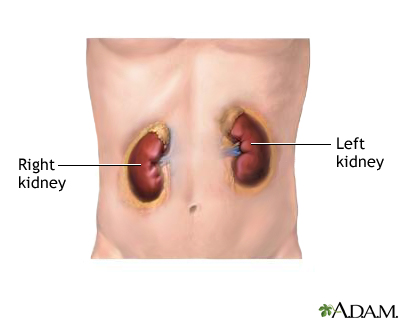

- Your kidneys clean the blood and manage water
Kidneys – most people have two. Their function is essential for life. If they stop working, then other types of filtration have to be used. We will talk about these back-up plans in a bit.
Think of your kidneys are filters, really good filters. They are about the size of your balled up fist. They are under your rib cage in the back.
Your kidneys have several functions
- Filter waste and toxins from the blood
- Remove extra water from the blood
- Turn the waste, toxins, and extra water into urine
- Urine removes all of those wastes and extra water from the body
Your kidneys have several parts
Nephrons in your kidneys are the filtering units. You have about a million of them – in each kidney! The nephrons have tubes that carry the urine. They also have small blood vessels that bring the blood past these tubes. The tubes can determine what to keep and put back in the blood and what to send on in the urine out of the body. They determine how much potassium, sodium, water and some other chemicals to keep or release. This is all regulated through a process called the renin-angiotensin-aldosterone system (RAAS).
Keeping and releasing the right amounts of these chemicals and fluids maintains balance in many other parts of your body. In particular, they have a big impact on your blood pressure. Your blood pressure is one important factor in how hard your heart has to work. When your heart has to work too hard for too long, damage can be done leading to heart disease.
The class of kidney-impacting medications that first comes to mind is diuretics. Many people call these ‘water pills’. They work directly in the tubes in the nephron that decide how much water to keep. The diuretics cause more water to be released into the urine and removed from the body. Lowering the total water in the blood lowers the blood pressure. [Note, this is NOT the same as changing the amount of water you drink. If you drink less you put yourself at risk of dehydration, and your kidneys will just hang on to the water it has causing you to urinate less rather than lower your blood pressure. So keep drinking plenty of water on these hot days even if you have high blood pressure. Your kidneys will take care of the rest.] There are a few different kinds of diuretics. Some are used primarily for blood pressure, some for heart failure, and some for edema or other conditions with large amounts of fluid retention.
Two other classes of medications that work through the RAAS system are angiotensin converting enzyme inhibitors (ACE Inhibitors) and Angiotensin II Receptor Blockers (sometimes called ARBs). Some examples of ACE Inhibitors are lisinopril, ramipril, enalapril. Note, the generic names of these medications end in ‘pril’. Some examples of ARBs are losartan and candesartan. Note, the generic names of these medications end in ‘sartan’. Both of these classes of medications have a direct impact on RAAS. This means they help control the amount of water that is excreted through the urine. They also impact the potassium (causing more to be kept in the blood) and have some other actions that lower blood pressure. They cause arteries and veins to open up more relieving pressure on the heart, kidneys, and other organs that have to work harder when these are squeezed tight. By opening them, the pressure slows down and the blood goes through these organs with less force. So these medications are used to treat high blood pressure, heart failure, kidney disease, and to protect the heart for people with diabetes.
When the kidneys just can’t work properly, then dialysis is used to provide the essential filtration. There are two main types of dialysis. One is hemodialysis that is performed in an infusion center. Someone requiring hemodialysis will go to the center about three times per week to be hooked to a machine which will filter the blood. This typically takes at least 2-4 hours. The other type is peritoneal dialysis that can be done at home. This requires an exchange of fluids through the abdominal area about four times per day. Each exchange takes about 30-40 minutes. You can learn a lot more about dialysis from the National Kidney Foundation at this link.
There is obviously a lot more detail needed to completely understand the function of the kidneys. The purpose of this article is to raise awareness of how very important those kidney-bean shaped organs are. It is well worth the effort to protect them. Some ways you can protect them are by keeping your blood pressure and diabetes controlled, staying well hydrated, and maintaining a healthy weight.
To learn more about your kidneys and medications that impact your kidneys, contact us at www.medsmash.com/contact.
BIBLICAL APPLICATION
The kidneys clean the blood. They remove waste, toxins, and extra water from the body.
We are called to be cleansed as Christians. How does that work?
First, what needs to be cleansed? Take an internal inventory on the following items to get started:
- Judgmental thoughts
- Angry words
- Hurtful actions
- Not helping when you could have helped
- Selfish motives
- Jealousy
- Lustful thoughts
Whew, that list could go on forever, couldn’t it! Yep, you’re a sinner. So am I.
Romans 3:23 (NIV)
for all have sinned and fall short of the glory of God,
So, should you just give up and go home? Or, should you give up and just do what you want since you can’t get it right anyway?
Romans 3:21-24 (MSG)
Since we’ve compiled this long and sorry record as sinners (both us and them) and proved that we are utterly incapable of living the glorious lives God wills for us, God did it for us. Out of sheer generosity he put us in right standing with himself. A pure gift. He got us out of the mess we’re in and restored us to where he always wanted us to be. And he did it by means of Jesus Christ.
Jesus died to cleanse YOU of all of your sin.
1 John 1:9 ESV
If we confess our sins, he is faithful and just to forgive us our sins and to cleanse us from all unrighteousness.
1 John 1:7 ESV
But if we walk in the light, as he is in the light, we have fellowship with one another, and the blood of Jesus his Son cleanses us from all sin.
Titus 3:5 ESV
He saved us, not because of works done by us in righteousness, but according to his own mercy, by the washing of regeneration and renewal of the Holy Spirit,
Since we have these promises, beloved, let us cleanse ourselves from every defilement of body and spirit, bringing holiness to completion in the fear of God.
Romans 12:2 ESV
Do not be conformed to this world, but be transformed by the renewal of your mind, that by testing you may discern what is the will of God, what is good and acceptable and perfect.
You can’t do it for yourself! Take all the baths you want. Do all of the good things you want for other people. Deny yourself all sorts of things. None of this will cleanse you.
But Jesus can. And He did! Just for you…
Blessings,
Michelle
Image source: National Library of Medicine, National Institutes of Health, U.S. Department of Health and Human Services.
 yourhealthandsoul