What do these words mean to you? What role do they play in your everyday life?
Wow, I am amazed how much information is available on this important link between being thankful and health. Just search for these two terms and see what all you will find.
What is gratitude?
This is being aware of all of the good things in your life. And it is being thankful for those things. Have you considered being thankful for:
A safe place to sleep
Food to eat
Clothes to cover yourself
Having a friend to call
Your job – current or past
A beautiful day
This simple awareness of and being thankful for these ‘little’ things can boost your health.
Note, it doesn’t have to be the biggest house or the softest bed or the tastiest food or the latest fashion clothing to be grateful. Gratitude focuses on what you have – all of the good things – rather than what you don’t have.
There are many ways you can make gratitude part of your life. Here are a few recommended in a Harvard Mental Health newsletter:
Write a thank-you note
Go up and thank someone
Keep a gratitude journal
Pray
Meditate
Keep a list of your thanks = count your blessings
See your day and your health improve by focusing on the positive. Try starting your day with a list of things for which you are thankful. On those nights you can’t sleep, name all of the good things in your life. Let that override the worries and things you can’t control.
On this Independence Day weekend, as a country, we have much reason for gratitude!
For more information on gratitude and health, contact us at www.medsmash.com.
BIBLICAL APPLICATION
We have so many reasons to be grateful!
Have you ever been in a ‘funk’ having a bad day and then remembered to be grateful? I have done this so many times. When all looks dark and gloomy, make yourself think about all of the things that are good and right.
Give thanks in all circumstances; for this is the will of God in Christ Jesus for you.
I’ll quickly admit I don’t always think to do this. I stay in that dark place far too long. Later, once I’m out I realize I had the ‘magic potion’ to leave that darkness behind. It was given to us by Christ when he died to erase our sins. It was given to us by God who maintained His love and focus on the good in the Jews through centuries of missteps (just as we live a series of missteps).
Every good gift and every perfect gift is from above, coming down from the Father of lights with whom there is no variation or shadow due to change.
I feel energized, positive, and excited just reading these verses full of hope and promise! I am thankful for each person who takes the time to read this. May you be blessed by these assurances from God!
I pray you can stay focused on the many good things in your life this week and that can keep you out of the dark, gloomy places.
There are growing resources, help, and hope for those with PTSD.
Posttraumatic Stress Disorder (PTSD) is finally becoming a topic that is discussed – in public. It finally has ‘a voice’ and several avenues of treatment to address it.
I was fortunate to serve about seven years of my career in the Veterans Affairs system. I worked alongside some of the best, most caring providers and the most robust interprofessional teams. These teams consisted of physicians (geriatricians who focus on people over 65, in my case), nurses, pharmacists, dieticians, physical therapists, occupational therapists, social workers, psychologists, psychiatrists, and every level of trainee – students, residents, and fellows. Together we provided care to aging adults in the clinic, the acute care hospital, the intermediate unit, long-term-care (nursing home), and the domiciliary. The ‘dom’ was long term, independent housing for veterans who did not have a family to live with after the war.
I am thankful for every veteran that has served our country in one of the countless ways our uniformed services care for this country every day. The stories I heard during those years were enlightening, empowering, endearing, and sometimes gut wrenching. I have heard others say this: In my experience, those who talked the least about their service saw the most ‘action’ and devastation.
One day I was in clinic with a student. It was a very normal day. As the pharmacist, my visits mostly pertained to medications – why, how, when they are taken and the result. On this day, during a normal pharmacy clinic visit, one of our veterans told his story. It forever changed my life. Here is a paraphrase. I will leave out the specific war, because the story could fit any of them.
“I was assigned the night guard shift for my platoon. It was my duty to walk around the perimeter of the base to look for anyone (of the enemy) who might try to attack at night. It was typically uneventful. One night, as I rounded a corner, I was face-to-face with a man from the ‘other side.’ In a split second I thought about my family – my wife and children. I thought about how I just want to go home to them. I thought I don’t know this man. I don’t hate this man. He probably has a wife and children waiting for him at home, too. We might even be friends in other circumstances.’
We all sat and cried for a long time.
After this event, this man, this veteran had a mental breakdown. He was sent to an island where soldiers not able to function in combat were stationed during that war. While there he started trying to stop reliving the event through alcohol. When he finally got home to his wife and children, he was an alcoholic. He had posttraumatic stress disorder. But, it wasn’t recognized, diagnosed, and treated as it is now. I certainly don’t know all of the details, but he and his family were not able to reunite and stay together. It broke my heart to see what had happened. I wonder if his wife and children ever knew what happened? I wonder if knowing could have changed the outcome for their family. No doubt he would be forever changed after an experience like that.
Post Traumatic Stress Disorder (PTSD)
PTSD is a condition where there is stress and symptoms for more than three months after a trauma or highly stressful event (or series of events). The stress and symptoms disrupt regular daily activities and are distressing. PTSD can result from war (as in the example above), natural disasters, sexual or physical assault, horror, accidents, or other terrifying event. PTSD can present in about four different ways.
Reliving the event – nightmares, flashbacks, triggers
Avoiding any reminders of the event – driving if in a car crash; crowds if they cause insecurity; fireworks if associated with gunfire; movies related to the event
Negative feelings or changes in feelings about the world and the future; suppressing or forgetting parts of the event
Treatment has multiple components. Understanding PTSD is an important step. Counseling and cognitive behavioral therapy can help. In cognitive behavioral therapy, people can become aware of thoughts and feelings, and that allows them to be processed and better understood. Then skills to face those feelings and make changes in a way that allows them to have less impact are developed. For each person, this process is different. There are highly trained, experienced therapists who will work with each personal individually.
For medication treatment, selective serotonin reuptake inhibitors (SSRIs) are most commonly used. These are medications that are also commonly used to treat depression and anxiety. They are unlikely to resolve symptoms alone. They are an important part of the multiple components of treatment.
Other components might be exposure therapy, group therapy, family therapy, and more.
A recommended site to learn more about PTSD is through the VA.
Again, there is a growing number of resources available to anyone who might be experiencing PTSD. If you or someone you know might have PTSD, please seek help right away. To suffer alone is not the answer. Alcohol, drugs, and suicide are not the answer. Help is available!
For more information about PTSD, contact us at www.medsmash.com.
BIBLICAL APPLICATION
PTSD is a real disorder. It is estimated about 3.5% of adults in the US have PTSD. Over 9% of people ages 50-65 have now or have experienced PTSD.
It can be hard to think rationally when suffering from PTSD. The terror, stress, and anxiety can keep the brain in ‘fight or flight’ mode. When in this mode, reflection, perspective, and problem-solving functions are very limited.
So, how can you support someone suffering from PTSD? Understanding the disorder and being a source of compassion and love are good places to start.
No platitude or Bible verse makes PTSD go away. Some Christian leaders have implied PTSD is something that can be chosen or can be avoided with a focus on God. I strongly disagree. Sinful people can hurt, traumatize, and destroy other people. Even people who know and love God can be traumatized.
But as people of God, we can support people who have suffered. If you have PTSD, know you are not alone. If you know someone who has (or you suspect may have) PTSD, approach with God’s unconditional love. Support through the many stages and steps of recovery and learning to cope. PTSD doesn’t just go away at some point; it might take a lifetime of coping and skill building to live in spite of past trauma.
There are many stories of violence, war, and crimes in the Bible.
These are followed by God’s restorative grace and mercy.
There are many verses about love, strength, deliverance, and rest for our soul.
In time, with treatment and a strong support network, these conversations can be had.
Until then, in the more acute phases when the brain is so busy with ‘fight or flight’ mode, prayer, presence, and unconditional love are ways you can start the story of grace.
Be on the lookout for people who may have PTSD who are not yet receiving treatment. Pray for the many people in our world who are PTSD victims. Love and care for those with PTSD in your life.
My dear, dear friends, if God loved us like this, we certainly ought to love each other. No one has seen God, ever. But if we love one another, God dwells deeply within us, and his love becomes complete in us—perfect love!
Supportive options when it’s time for end-of-life care.
Now we turn to end-of-life care. Last blog we talked about the U-turns available in your life and health. These can help you feel better and live healthier. We learned you can still make changes that have a positive impact on your overall health.
We can’t stop it. We won’t be able to turn it around. There are a number of conditions that at this moment have no cure or way to get rid of them.
When we run out of options, then the end of life becomes our focus. This is peaceful for some. It is frightening and a huge struggle for others. It impacts not only the person diagnosed but also all of their friends and family. Each person involved deals with a number of feelings during this time. There can be guilt, fear, conflict, regret, and grief, among others.
The support of others, education about what is happening, and sources of comfort are critical.
Resources for end-of-life
Following are some resources for everyone involved in end-of-life care.
Support groups – There are support groups for most common diagnoses, for people with the diagnosis and for caregivers and family members, and for various stages of the condition.
Caregiver stress and burden – Caring for a loved one near the end of life can be emotionally and physically exhausting. There are many resources that provide assistance (such as in-home care agencies) or respite (short term stays while the caregiver takes a break).
Caregiver care – A caregiver can’t fully care for their loved one if they don’t also take care of themselves. Emotional, physical, and spiritual health need attention during this demanding time.
Resources – Your community will have various agencies available to provide numerous sources of help. These include direct healthcare, legal guidance, financial aid, spiritual support, placement options, and more. If the person nearing end-of-life is over age 65, your local Agency on Aging could be a valuable source of lists of the resources available in your area.
Palliative care – This is care that is focused on comfort and support to accomplish goals toward the end of life.
Hospice is one form of palliative care. Your hospice organization can support you, provide education about current and future changes, and help you with preparation for all involved.
When the end-of-life can be anticipated (vs suddenly taken), there is an opportunity to prepare and fully live those final months or days.
For more information about end-of-life options, contact us at www.medsmash.com.
BIBLICAL APPLICATION
What’s different about the people that find peace in the end of life?
“For God so loved the world, that he gave his only Son, that whoever believes in him should not perish but have eternal life.”
The hope we can take through those seasons of palliative care and hospice is the result of anticipating the end of this life and moving on to eternal life.
Truly, truly, I say to you, whoever hears my word and believes him who sent me has eternal life. He does not come into judgment, but has passed from death to life.
For by grace you have been saved through faith. And this is not your own doing; it is the gift of God, not a result of works, so that no one may boast.
If this life is just the preamble to a life of eternity with Christ, then death loses its sting.
The fourth of the four components of health is emotional health. True health requires health in all four components. Over the last three weeks we covered physical, mental, and spiritual health. Striving to attain health in all four areas enhances your overall health.
Emotional health refers to how you deal with life and its ups and downs. Everyone goes through difficult trials. The specifics are different between people. Even for you, there will be a wide variety of difficult times you experience. Everyone has good days. These can be peaceful, contended days; days where you reach a goal; days where you are celebrated; and days when you feel loved and secure.
Your feelings play a big role in your emotional health. People express their feelings in many different ways. Some people are more visibly emotional. Other people keep their emotions carefully hidden from view. Either way, emotions can impact our behaviors. How we act, how we respond, how we treat people, and how we feel about ourselves can all be affected by our emotions.
Why does my emotional health matter?
When looking at the differences between healthy people and not so healthy people, researchers have found emotional health to be a key factor.
How do you handle your anger? How kind are you to yourself in your ‘self talk’? How do you express your joy? What is your response when someone criticizes you? How often do you put other people’s needs before your own? Do you feel like the world is out to get you? How do you respond when your car breaks down? How do you feel when you forget to send a birthday card on time? What makes you happy? What makes you sad?
Studies have shown that prolonged stress and negativity make you age faster. There are actually measurable changes in your brain (shorter telomere length and less activity). This stress can also make you more susceptible to other diseases. Your blood pressure can go up, risk of heart disease goes up, and risk of diabetes goes up.
Improved health does not come from lack of negative situations. It comes from how you handle those situations.
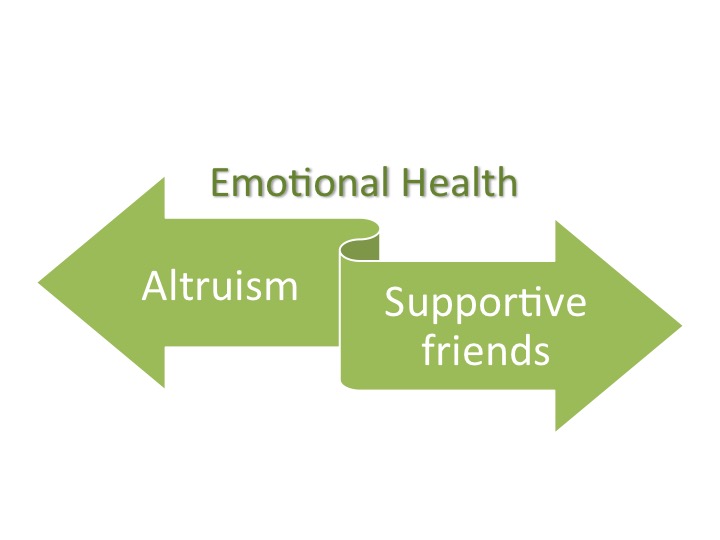
The research has shown that the people who are more emotionally healthy have:
Friend(s) to talk to
People who care about you
A sense of self-worth
Ability to give and receive forgiveness
Conflict management skills
A desire to be giving toward others
Concern for others
As you can see, these are not things you are born with. They are skills and attitudes you can develop. They are choices you can make. They are best navigated with friends and supportive people around you.
Similarly, other researchers found that keys to overall health are:
Thinking kindly of people
Feeling optimistic
Supportive friends & family
Ability to bounce back
Making healthy choices
Being grateful for all you have
I found it interesting that the findings are so similar. Other studies have supported these important areas of emotional health. When you feel good, your thinking of more creative and flexible. You see problems with more possibilities and solutions.
So, I encourage you to take a personal assessment of your current emotional health. Consider the things that delight you and the things that upset you. Where can you incorporate more of the listed items that are shared among people with more emotional health?
Medications can help on a short-term basis when circumstances have you so upset you can’t function or sleep. Long-term emotional health, however, is gained more through self-insight, positive choices, and self-development.
If you would like citations for the studies mentioned or have any questions about the role of your emotional health on your overall health, contact us at www.medsmash.com.
(Note, severe abuse, neglect, and trauma are much different than daily negative situations. This blog is not intended to cover the health effects of these experiences that usually involve severe mental illness of the perpetrator.)
BIBLICAL APPLICATION
Our emotions can guide so many of our behaviors, especially if we don’t have an anchor of hope. Resilience is the result of knowing God’s love and mercy never fail. No matter the situation, you are not alone, and you have the ultimate resource walking with you.
Throughout the Bible we are assured that bad things will happen. Since sin entered the world, this has been a basic fact. Throughout the Bible we are assured there is hope and joy that can get us through any situation.
Do not be anxious about anything, but in everything by prayer and supplication with thanksgiving let your requests be made known to God. And the peace of God, which surpasses all understanding, will guard your hearts and your minds in Christ Jesus.
Have I not commanded you? Be strong and courageous. Do not be frightened, and do not be dismayed, for the Lord your God is with you wherever you go.”
As we go through difficult times, either big life-altering events or short bursts of anger or frustration, we are encouraged to give those over to God. We aren’t meant to figure it all out or deal with it on our own. Actually, when we do try to handle things ourselves, we often get into trouble.
Do not be conformed to this world, but be transformed by the renewal of your mind, that by testing you may discern what is the will of God, what is good and acceptable and perfect.
A glad heart makes a cheerful face, but by sorrow of heart the spirit is crushed.
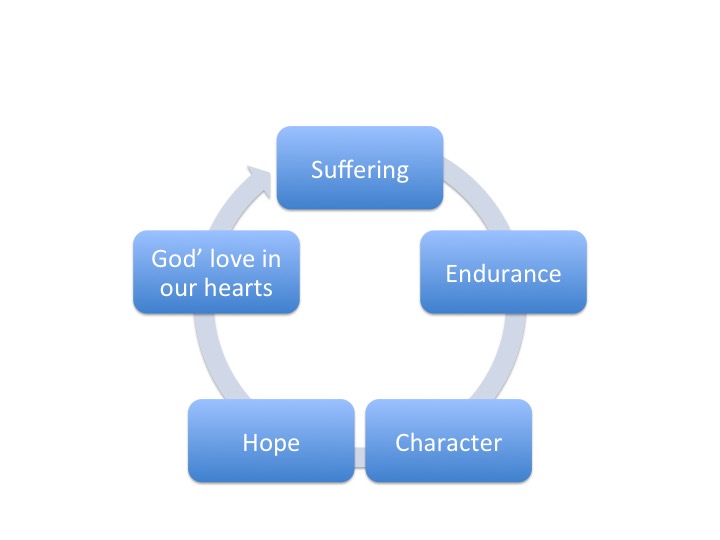
I love this visual of Romans 5:3-5. With each time around the circle, we grow in hope and joy and the certainty of God’s love. This can then spill over to others.
Spiritual health is the third of the four components of health. True health requires health in all four components. Over the last two weeks we covered physical and mental health. Next week we will cover the fourth component.
This blog is being released on the most important holiday of the Christian religion. It seems timely to talk about spirituality and why and how it is linked with your health.
Researchers have studied what are the differences between the most healthy and the least health people in our world. Certainly some of the factors are:
our genes
our environment
our accessibility to healthcare
our social system
These are more tangible, or objective, types of factors. We can define and measure them. But, these measures alone can’t explain all of the differences in our health.
A component that many researches have included is the concept of religion. Most studies I have found don’t differentiate which religion. They just look at whether the person identifies with a religion. Studies have found that identifying with religion is associated with better health.
Why would spiritual health and religion be associated with better health?
One potential reason religion could enhance your health could be belief in a higher power. There is assurance and hope in having someone/something overseeing your life. In some religions there is a direct relationship with the higher power. In others, a common belief system provides a group to whom you can belong and share those beliefs.
Religion has also been credited with providing a way of coping with life events. In some religions, God can be asked for help. Some studies have demonstrated a positive benefit of prayer on health. In others, the care of one another by people within a religious group benefits health outcomes.
The sense of belonging, the social opportunities, and the structure of religion appear to add to enhanced health. In addition, religion provides additional opportunities for volunteering. Those who volunteer have been found to be healthier. Of course, there are non-religious ways to volunteer. But, some of the studies found those with a religious affiliation to be more likely to volunteer.
Altruism is one of the attributes associated with improved health. Altruism is defined as, “feelings and behaviors that show a desire to help other people and a lack of selfishness” (Merriam-Webster definition). Some of the major religions – Judaism, Christianity, and Islam – encourage helping others. Then, God will reward such actions. Either way, people who think about and do positive things for other people are healthier.
There is growing interest in studying this. There is now evidence to support the crucial role of spirituality in overall health. Stay tuned to see how this information will be incorporated in to our healthcare system.
There are no medications for spirituality. So, you might wonder why Meds MASH would be posting about this topic. But, it is a core part of overall health. So in the interest of completeness, spirituality is an important topic.
For a list of references used in the writing of this blog, please contact us at www.medsmash.com.
BIBLICAL APPLICATION
Happy holiest of days! Our Savior lives!
The sun has been shining, the days are warming, my favorite color of spring green is starting to turn up everywhere, flowers are blooming! This season makes me so happy!
Have you noticed how circumstances can really improve your mood and make you happy?
I’ve injured my leg (again) and will likely need surgery. Insurance has made the treatment process incredibly long. How frustrating. Have you noticed how circumstances can dampen your mood?
How much is your life tossed up and down by circumstances? The roller coaster ride of the ups and down can be exhausting!
You can’t keep life circumstances from happening. Good things and bad things happen to everyone. There is no avoiding it. But, you have the ultimate hedge of protection around you like a solid house that protects you in a hurricane. No matter what happens in your life, because of what happened Holy Week, you have a source of hope and peace.
Jesus was betrayed by one of his closest friends. Many people worked together behind his back to find a way to destroy him. He was slandered. He experienced the ultimate defamation of his character. He was accused of crimes he never committed. He was humiliated. He was physically abused beyond recognition. He was tortured. Many who had supported him either abandoned him or turned against him. The official who could have protected him did not. He was murdered in public with additional humiliations in the worst, most painful way known to people at that time.
He was completely without sin. He did nothing wrong. He is the only person to ever walk the earth who could claim that.
So, why did he willingly go to Jerusalem on Palm Sunday knowing full well this was what would happen by the end of the week?
But he was wounded for our transgressions; he was crushed for our iniquities; upon him was the chastisement that brought us peace, and with his stripes we are healed.
“For God so loved the world, that he gave his only Son, that whoever believes in him should not perish but have eternal life.
YOU are the reason Jesus endured all of this. His love for YOU. Your sins. All that separated you from God due your weaknesses is now gone. Because Jesus died for YOU, you have the promise of eternal life! There is no better gift anyone could ever give you.
Jesus did not remain in the grave. After three days He came back to life! Again, all for YOU!
For this is the will of my Father, that everyone who looks on the Son and believes in him should have eternal life, and I will raise him up on the last day.”
Medicine doses should be adjusted with weight loss
least lower doses.
Healthy weight loss can lead to decreased doses
Unhealthy weight loss can, too. Actually, sudden, unexpected, or drastic weight loss can be even more hazardous. If it is unplanned please talk with your doctor right away.
Fat loving (lipophilic) medicines distribute throughout all of the extra weight in our bodies. The medication finds places to travel and stay stored in all of these fatty areas. Once we lose fat, it takes a lower dose to get the same effect. If the dose is not changed with weight loss, the same dose you have taken for years can actually be toxic. Rather than being stored in the fat, the amount of medicine stays in your blood where it has more effect. I have seen several cases where someone was getting more confused, more sleepy, having more difficulty thinking with no change in their medicine regimen. Upon further analysis, we found they had lost several pounds over the past several months with no reduction in medicine dose. So talk with your doctor as you lose weight to double check doses of meds.
Medical conditions related to weight
There are also several medical conditions that are related to your weight, especially excess weight. For many people diabetes, high blood pressure, and high cholesterol are found when the person is overweight. They get worse with increased weight. If that person then loses weight, those medical conditions can get better. The need for medicines to control these conditions can go down as the body is better able to manage the blood sugar, blood pressure, and cholesterol on its own. This means the number and doses of medicines might also need to be decreased. Blood pressure medicine doses that are too high can lead to dizziness, especially with standing, and falls. Diabetes medicine doses that are too high can lead to low blood sugar, confusion, dizziness, sweating, or even passing out. Cholesterol medicine doses that are too high might increase risk of side effects like liver damage or muscle pain.
If you have diabetes, high blood pressure, or high cholesterol and have lost at least five pounds, ask your doctor if you could take fewer medicines or lower doses.
What are other benefits of weight loss?
Data has shown that a 5% weight loss can help prevent high blood pressure. It can also help control your blood pressure, your diabetes, and your cholesterol. So, if you weigh 200 pounds, this would be a 10 pound weight loss. This can be accomplished through diet and exercise. Fast weight loss fad diets are NOT the diets of choice. Eating healthy foods, vegetables, fruits, and low-fat options are the safest diet changes. Also, exercise does not mean running a marathon tomorrow. Increased movement several times each day can have a huge positive benefit.
I had one patient once who took this message to heart. He gradually changed his diet and started walking. None of his changes were extreme. Over time, he lost weight. We were able to remove EIGHT medicines from his regimen as his own body resumed control of his conditions. Not everyone will have results this dramatic, but small changes can have big positive impacts.
For more information about healthy weight loss and associated medicine reductions, please contact us at www.medsmash.com.
BIBLICAL APPLICATION
In line with these thoughts about the positive benefits of weight loss, consider the benefits of guilt loss! How much of your daily activity is influenced by guilt? Do ayou feel worthy, accepted, loved, precious, and good enough? Or, do doubts cast a shadow over you? Do feelings of guilt or shame impact your confidence and your attitude? Are you as positive and hopeful s you could be?
If you could shed guilt and shame, can you even imagine how much lighter your load would be? Think how much freer you would be to rejoice and praise and live the life you were meant to live!
Here are some of the thoughts in the Bible about guilt.
Come to me, all who labor and are heavy laden, and I will give you rest. Take my yoke upon you, and learn from me, for I am gentle and lowly in heart, and you will find rest for your souls.For my yoke is easy, and my burden is light.”
The past is gone. You are forgiven! You do not need to carry around this guilt and shame. Shed it and see how good you can feel!
To put off your old self, which belongs to your former manner of life and is corrupt through deceitful desires, and to be renewed in the spirit of your minds, and to put on the new self, created after the likeness of God in true righteousness and holiness.
Blessings,
Michelle
Image Source: National Center for Complementary and Integrative Health; National Institutes of Health; U.S. Department of Health and Human Services
This is such a joyous exciting season! Many faiths have reason to celebrate this time of year. Many people have long-held precious traditions. Family and friends make special effort to be together. Receptions, parties, brunches, gatherings, and meals are planned.
Do find that this season gives you energy and good, warm feelings?
Or, do elements of this season make you anxious?
Do the preparations, busy calendar, and financial outflow give you stress?
I hope not. But if they do, you are definitely not alone. About 44% of women and 31% of men report an increased level of stress at holiday time. Some rate the hype, finances and issues as mentioned above, as the source of their stress. Others point to discomfort with social situations.
I want to share something helpful I recently read. It is interesting that we each feel like others are looking at and judging us in such situations. In reality, all of those people are having the same self-conscious feelings about themselves.
So, if you are feeling additional stress, what are your best alternatives to manage it?
Alcohol may seem like a good option, but it actually puts you at risk for a fall or a driving accident. Then, it makes you feel even more tired the next day. And, alcohol and drugs can make your stress worse rather than better.
A class of medication used for stress for decades is benzodiazepines. These medications include alprazolam, lorazepam, diazepam, and brand names like Valium and Xanax. They have made the lists of medications that are not safe for most people over the age of 65. They aren’t good options for people under age 65 either with very few exceptions. They make it hard to think clearly, increase risk of falling or other injury, and increase risk of driving accidents. When these are taken regularly, dependence develops. Then it becomes hard to get back off of them. So, I recommend you DO NOT use benzodiazepines to manage holiday stress.
A good night of sleep can be very helpful in dealing with stress. But, using medicine to get to sleep can put you at risk. These medicines include zolpidem/Ambien, zaleplan/Sonata, and eszopiclone/Lunesta. This list also includes over-the-counter sleep aids like diphenhydramine found in Benadryl, Tylenol PM, and Aleve PM. Doxylamine is another ingredient found in sleep aids and cold/flu combinations that has strong anticholinergic side effects. This means it can cause constipation, dry eyes, falls, and can cause slowed thinking.
So what are some safer ways to manage holiday stress?
Take care of yourself :-).
Healthy tips
Eat healthy foods, including plenty of fruits and vegetables. Limit fattening party foods.
Drink plenty of water/fluids to avoid dehydration while running around busy. Limit the caffeine to avoid the ‘crash’ later and to protect your heart.
Get some exercise to clear your head and improve your mood.
Get a good night’s sleep. Note, the exercise and avoiding alcohol will help with your sleep.
Take a break. Taking some time to relax, pray, meditate, or get a massage can help you recalibrate.
For more information about manageing holiday stress, contact us at www.medsmash.com.
BIBLICAL APPLICATION
Does the Bible give any guidance about managing stress? Oh yes, from the dawn of time people have had fears, doubts, stress, and anxiety. Repeatedly, God has called us back to him. He repeatedly tells us that HIS peace is sufficient and beyond our understanding. Let some of these verses bring you a new perspective.
Anxiety in a man’s heart weighs him down, but a good word makes him glad.
The list of related Bible verses goes on and on. We were not created to live in anxiety and stress. May the peace of our Lord and Savior be yours this Christmas!
Did you know there is a list of medications to avoid over age 65? A group of physicians and other experts first published this type of list in 1991. Since that time, the list has been updated several times. The most recent update was released this October of 2015. The list is of medications for which there were safer, as effective options. Mark Beers is the physician who took the lead with these lists, so they are often called the ‘Beers List’.
Did you know that kidney function starts to decline – in the healthiest of people – around age 40? The liver also slows down as we age. The efficiency of the heart pumping is more than we need until about age 30, then it starts to slowly decline.
This is not all bad news. The body is designed to function for a very long time, even with the changes that occur with aging.
The more you keep yourself, and your body, healthy, the better you will feel for many years.
Getting back to the naughty list, these body changes slow how medications get out of the body. So often, a single dose will last longer in your 70’s than it did in your 30’s. This means some medications are dosed at a lower dose. Other medications are taken less often. And the Beer’s list medications should not be taken at all.
Beer’s list medications:
Anticholinergic medicines are very drying, increase risk of falls, increase confusion and constipation. A common example is diphenhydramine found in Benadryl, Tylenol PM, Aleve PM, and most over-the-counter sleep aids.
Certain blood pressure medicines that can make you very dizzy when you stand up – doxazosin, prazosin, terazosin, clonidine, methyldopa, nifedipine
Digoxin – if used, should be used a very low dose such as 0.125 mg daily
Some depression medicines like amitriptyline, imipramine, notriptyline, paroxetine have a lot of side effects. There are some effective antidepressants that are safe, have fewer anticholinergic (drying and confusion) effects, and less drop in blood pressure.
Benzodiazepines include alprazolam, lorazepam, oxazepam, temazepam, triazolam, clonazepam, diazepam. If you are taking one of these for anxiety, please talk with your doctor at your next visit about reducing and gradually coming off of this medication. They greatly increase your risk of falls, difficulty thinking, car crashes, and delirium.
Mineral oil. There are much safer remedies for constipation or any other use of mineral oil.
Meperidine is one of the most risky pain medications in older adults due to the slower ability of the body to get rid of it. Talk with your doctor about one of the many safer options.
Skeletal muscle relaxants include cyclobenzaprine, methocarbamol, orphenadrine, carisoprodol. These have anticholinergic (drying) effects, make you sleepy, and increase your risk of falls and fractures. In addition, they don’t have very good evidence that they are actually helpful.
Nonsteroidal pain medicines, especially indomethacin and ketorolac, can cause stomach bleeding and dizziness. Other common nonsteroidals are ibuprofen, Naprosyn, meloxicam, or etodolac. If you take one of these, talk with your doctor about taking it with an acid blocking medication to help protect your stomach.
There are other medications on the list. Some are specifically hazardous if you have certain other medical conditions.
DO NOT STOP or change the way you take any medicine without first talking with your doctor.
This is a long list. Please discuss this with your doctor if you are taking any of these medications.
Or, please contact us at www.medsmash.com. We are experts in medications for adults over age 60. We can explain the list and any hazards in your medication list to you. Then, we can work with your doctors to make safer changes.
BIBLICAL APPLICATION
Here are two key ‘Nice Lists’. In these times of holiday activities and worldwide turbulence, I hope these bring hope and joy. The Bible says these are to help us glorify our God in Heaven.
3 “Blessed are the poor in spirit, for theirs is the kingdom of heaven.
4 “Blessed are those who mourn, for they shall be comforted.
5 “Blessed are the meek, for they shall inherit the earth.
6 “Blessed are those who hunger and thirst for righteousness, for they shall be satisfied.
7 “Blessed are the merciful, for they shall receive mercy.
8 “Blessed are the pure in heart, for they shall see God.
9 “Blessed are the peacemakers, for they shall be called sons[a] of God.
10 “Blessed are those who are persecuted for righteousness’ sake, for theirs is the kingdom of heaven.
11 “Blessed are you when others revile you and persecute you and utter all kinds of evil against you falsely on my account. 12 Rejoice and be glad, for your reward is great in heaven, for so they persecuted the prophets who were before you.
Some of the greatest gifts of the season can be love, tolerance, patience, and peace.
I will be praying for each of these for each of us.
your skin weighs about 9 pounds (for the average adult)
your skin covers about 21 square feet (for the average adult)
your skin plays a big role in regulating your body temperature
the melanin in your skin is responsible for its color
As our chief protector, our skin deserves some respect, care, and attention.
Burns
In this season of celebration, there is often a lot of cooking. For me anyway, that means an increased likelihood I’ll burn myself. If the same is true for you, here are some facts about treating your burns.
First, if a burn is larger than 2 inches, on a very tender area, or caused by a fire, electricity, or chemicals, go get it checked out by your doctor or the emergency room.
Cool the burn with cool (not cold) water.
For a minor burn, wash it with mild soap and water then cover with aloe vera or petroleum jelly (not butter, egg, cortisone, lotion, or oil).
Do NOT break blisters.
You can cover with nonstick gauze to help protect the burn.
If your doctor has approved you taking over-the-counter pain medicine like acetaminophen (brand Tylenol), ibuprofen (brand Motrin), or naproxen (brand Aleve), this can help control the pain. NOTE, avoid aspirin in children under 2 or people recovering from chickenpox or flu.
Do not scratch the burn as it heals (it will be itchy).
Consider a tetanus shot if you have not had a booster within the last 10 years.
Dry Skin
This is also the season where we often spend more time indoors with the heat on (if you’re in a more northern climate). This plus the blustery, drier air outside, can make your skin more dry. When your skin gets too dry, it can crack and lose its ability to protect you. Here are some tips to help you keep your skin moist:
Limit your bath/shower to 10 minutes and avoid very hot water.
Blot your skin dry gently after cleansing.
Apply an ointment or cream after cleaning. Note, these will moisturize better than a lotion, and you don’t have to buy the expensive products. I recommend the generic or store brand that’s on sale.
Choose ointments and creams without fragrance. Fragrances and other additives can further irritate skin.
Wear lip balm.
Protect your skin when outside with gloves, scarves, and hats.
As good as it feels, sitting in front of the fire or heater can further dry your skin.
Skin Cancer
1:5 Americans will have skin cancer in their lifetime. Be sure to show any changes in moles, spots, or other skin markings to your doctor. Use of sunscreen, even on cloudy days, helps protect your skin from harmful UV rays. The earlier a skin cancer is detected, the easier it is to treat, typically.
So, enjoy the beauty and festivity of this holiday season, and keep your chief protector, your skin, moist and healthy.
For more information about skin protection, contact us at www.medsmash.com.
BIBLICAL APPLICATION
Are you afraid? Do you feel exposed and at risk?
I know several people who are dwelling on the events in the news. It seems there is so much bad news. There is so much killing and strife. Wars are being waged in new, frightening ways. People are living in fear of one another on the basis of superficial labels of race, religion, or skin color rather than the person inside the skin.
Protection from fear and evil is on many minds and being spoken about at many dinner tables.
I often read (and try to memorize) Psalm 121 at times like these. It begins with:
I lift up my eyes to the hills. From where does my help come? My help comes from the Lord, who made heaven and earth. He will not let your foot be moved; he who keeps you will not slumber. Behold, he who keeps Israel will neither slumber nor sleep. The Lord is your keeper; the Lord is your shade on your right hand.
I encourage you to listen to ‘Praise you in this storm’ by Casting Crowns. It incorporates this Psalm into a beautiful message of hope in God. https://www.youtube.com/watch?v=EjZBZv_771o
There is hope at all times, even these times of turmoil. Jesus gives us the spoiler alert about how all things will ultimately resolve in Him.
Interestingly, studies have shown that more money is not linked to happiness. Actually, more money is associated with higher depression and anxiety rates.
Thinking kindly about other people and helping other people is linked to health, living longer, and overall well-being. Rather than focusing on yourself and your own problems, who could benefit from your care?
Studies have repeatedly demonstrated that happier people are healthier people. It is fascinating that happier people don’t necessarily have more stuff, live with more innovations, or have more resources. This is especially true for psychological and emotional health.
Feeling optimistic that good things are going to happen
Having supportive family and friends
Being able to bounce back from bad situations and make healthy choices
Some aspects of health go beyond diagnoses and medications. Perhaps those elements are at our deepest core and the ones that need the most attention.
Hope is integral to happiness. It is also a key aspect of recovery. It is the element that pulls you away from the slippery slope to negativity. Many people with hope usually believe in a higher power with a sense of spirituality.
So, again, ask yourself, what makes you happy? For what are you grateful? What is your source of hope? What changes can you make today to do something helpful for another person?
The answers could be your source of health.
For more information about the literature on this topic and the relationship between happiness, hope, and health, contact us at www.medsmash.com.
BIBLICAL APPLICATION
So what are the answers to the questions? God, your loving, merciful, forgiving, creator is the source of all hope. Have you experienced that grace? Are you confident in that unconditional love?
It is hard to imagine life without this source of hope. What would each day be like not knowing the God of the universe?
If you do not have a daily, personal relationship with God, keep reading.
God can be your source of hope to get beyond anything that has happened in the past, of strength in the present, and of excitement for the promises of the future.
For I know the plans I have for you, declares the Lord, plans for welfare and not for evil, to give you a future and a hope.
You are deeply and unconditionally loved. God has big plans for you.
Bad things will still happen. Some days will be harder than others. Most of the future will be unknown. (But we know the ultimate outcome is eternal life in Christ!)
Through him we have also obtained access by faith into this grace in which we stand, and we rejoice in hope of the glory of God. More than that, we rejoice in our sufferings, knowing that suffering produces endurance, and endurance produces character, and character produces hope, and hope does not put us to shame, because God’s love has been poured into our hearts through the Holy Spirit who has been given to us.
May this hope and love be your source of happiness and health!



 Blessings,

 This is such a joyous exciting season! Many faiths have reason to celebrate this time of year. Many people have long-held precious traditions. Family and friends make special effort to be together. Receptions, parties, brunches, gatherings, and meals are planned.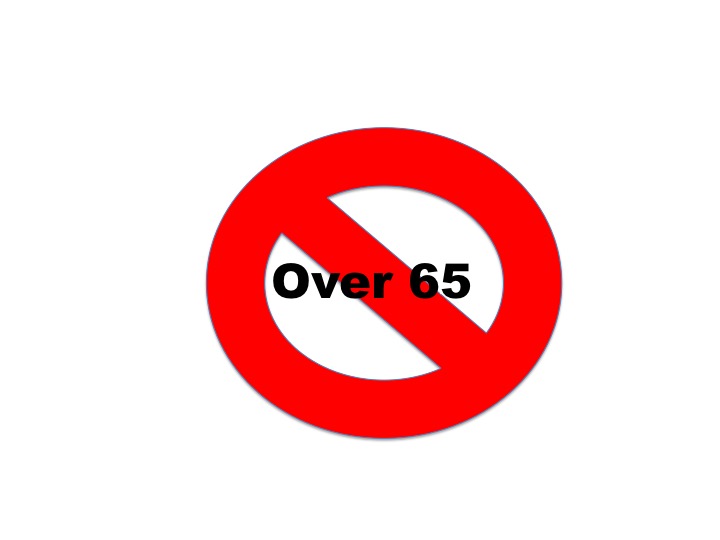
 Did you know there is a list of medications to avoid over age 65? A group of physicians and other experts first published this type of list in 1991. Since that time, the list has been updated several times. The most recent update was released this October of 2015. The list is of medications for which there were safer, as effective options. Mark Beers is the physician who took the lead with these lists, so they are often called the ‘
 Here in this season of thankfulness and celebration, I offer you a part of yourself worthy of thanks and great care.
 What defines your best days?
 yourhealthandsoul